
How to Protect Your Ideas Before You Speak
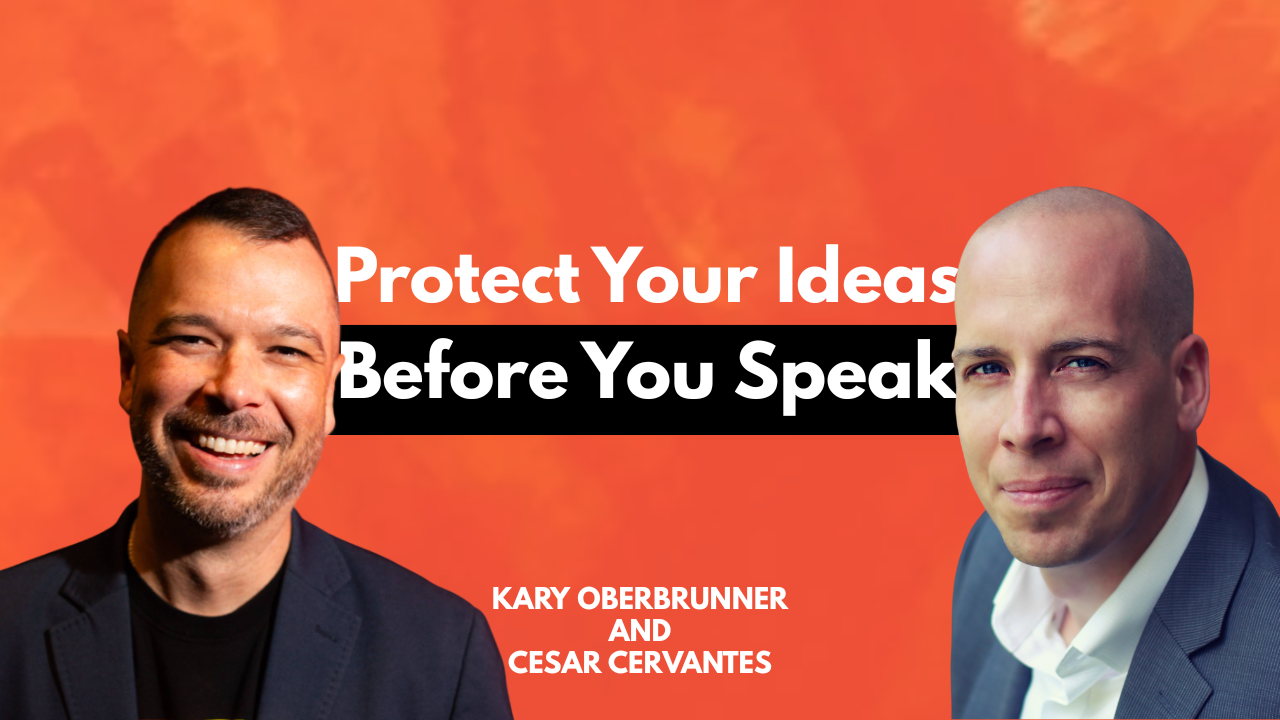
I just wrapped a conversation (video below) with Kary Oberbrunner, bestselling author, speaker, and founder of Instant IP. He’s helped thousands of creators, speakers, and authors protect their ideas and what he shared in this session completely reframes how most people think about intellectual property.
If you’re a speaker, coach, or creator putting ideas into the world, this is one of those conversations you don’t ignore.
Most people are creating content every day but don't have any protection around it. And in a world where AI can scrape, clone, and replicate ideas faster than ever, that becomes a serious risk.
Let’s break it down...
1. You Already Have IP (You Just Don’t See It Yet)
Most people think intellectual property means patents, lawyers, and expensive filings.
Kary breaks that illusion very quickly.
If you have a website, a logo, a book, a talk, a framework, or even a name or phrase, you already have intellectual property. The problem is not creation. The problem is recognition.
Your slides, your talks, your frameworks, your content—it all stops being “just content” and starts becoming an asset system.
2. The Real Risk Isn’t Theft, It’s Speed
One of the most striking parts of the conversation wasn’t even about legal protection, it was about velocity.
AI now allows people to record your talk, feed it into tools, recreate your frameworks, and even train models on your voice, ideas, and systems.
Kary shared real examples of artists and creators losing control of their work not because they weren’t good, but because they weren’t first.
That distinction matters more than ever.
3. Most Creators Follow the Wrong Order
Kary calls it the broken content cycle: publish, promote, profit.
But what’s missing in that sequence is the part that determines whether any of it actually lasts—protection.
Without it, everything else is built on unstable ground.
The real flywheel, as he explains, is publish, protect, promote, then profit. Most people only think about visibility and monetization, but protection is what actually creates leverage.
4. “Everything Gets Stolen” Is a Dangerous Mindset
A common belief came up during the conversation: if everything gets copied anyway, why bother protecting anything at all?
Kary’s response was simple but sharp. Intellectual property is like a house. Leaving it unprotected doesn’t make you generous—it just makes you exposed.
And while not everything needs a patent or heavy legal structure, anything valuable should at least have a timestamped proof of creation. Because when disputes happen, time is everything.
5. The Future of IP Is Time-Stamped Proof, Not Paperwork
This is where the conversation shifted into something bigger.
Traditional IP systems—patents, copyrights, trademarks—were never designed for the speed we’re operating at today. They’re slow, expensive, and often reactive.
Meanwhile, ideas now move instantly across platforms and AI systems.
Kary’s argument is that blockchain changes the equation, not by replacing legal systems, but by proving time. And in intellectual property, time is ownership leverage.
That alone changes how creators need to think about their work.
6. Most People Are Accidentally Inviting Theft
One of the more counterintuitive insights was that even well-meaning creators are often exposed without realizing it.
They share frameworks without protection, use “TM” incorrectly, assume attribution equals ownership, or simply wait until something feels “big enough” to secure.
Kary’s point was direct: don’t wait until you’re big to protect your ideas. You become big because you protected them early.
7. The Real Strategy: Treat Your Ideas Like Assets
At the core of everything is a shift in identity.
You’re not just producing content—you’re building assets.
That means naming your frameworks, defining your systems, documenting your IP, creating a record of first use, and turning ideas into structured, ownable property.
Because once something is named and structured, it becomes defensible. And defensible ideas become licensable, scalable, and monetizable.
8. The Shift: From Creator to IP Owner
The most important shift in the entire conversation is this that creators think in content, but IP owners think in systems.
Content disappears after a post. Systems compound over time.
And since AI can replicate almost anything except provenance, the winners won’t just be the most creative people. They’ll be the ones who can prove what they created, when they created it, and how it connects to a larger system.
CLICK HERE TO START PROTECTING IDEAS THROUGH INSTANT IP. YOUR FIRST ONE IS ON ME!

